We may earn a commission from purchases through links in this article, at no extra cost to you. How we earn
Direct Answer Verdict
High-Output Ground Plane Rework
For multi-layer ground planes and continuous rework, 200W-class platforms compatible with C245 cartridges provide the thermal delivery required to prevent joint freezing.
Precision Micro-Soldering
For fine surface-mount devices and compact micro-pads, stations built around low-resistance C210 or C115 cartridges offer compact tip-to-grip geometry and fast response.
Platform Differentiation
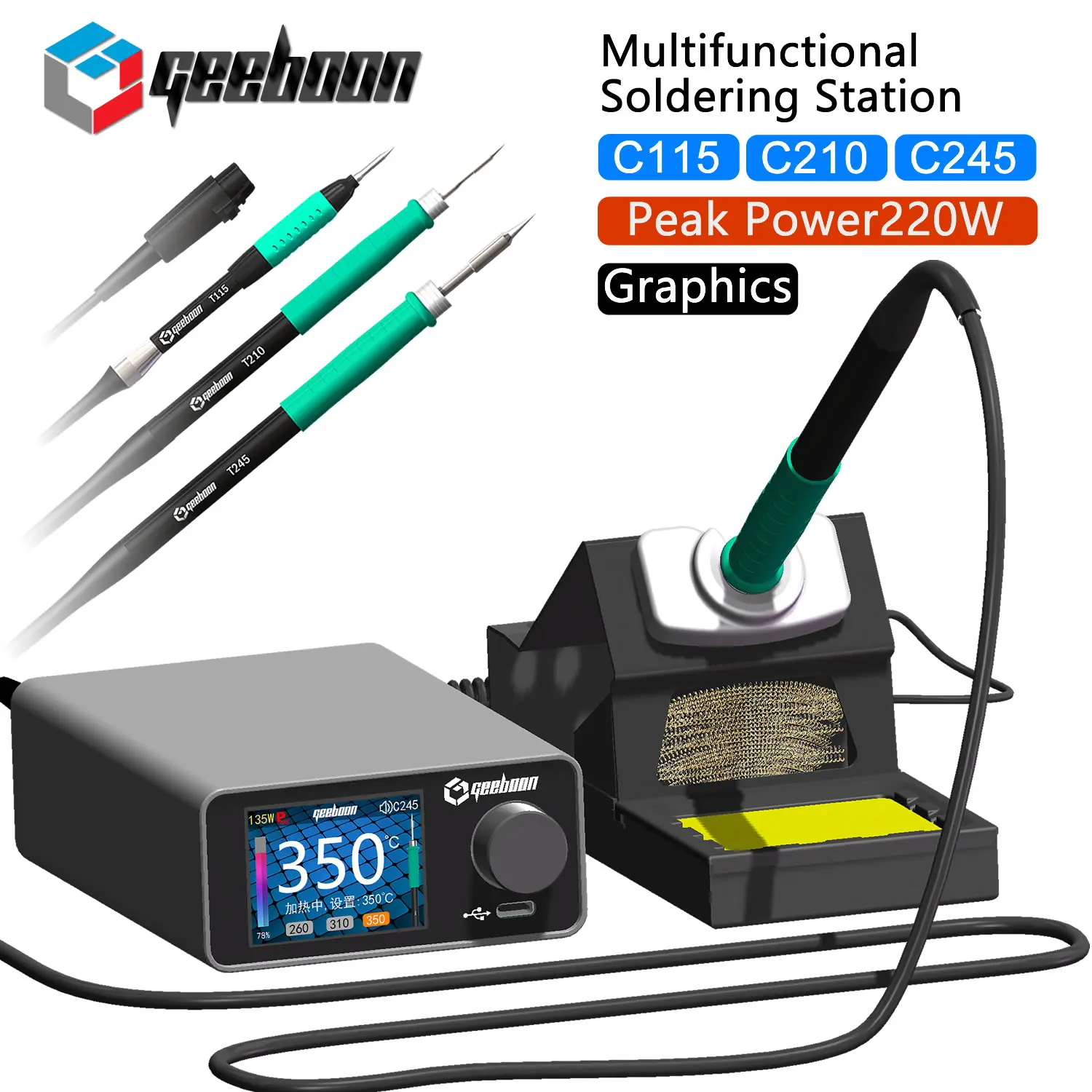
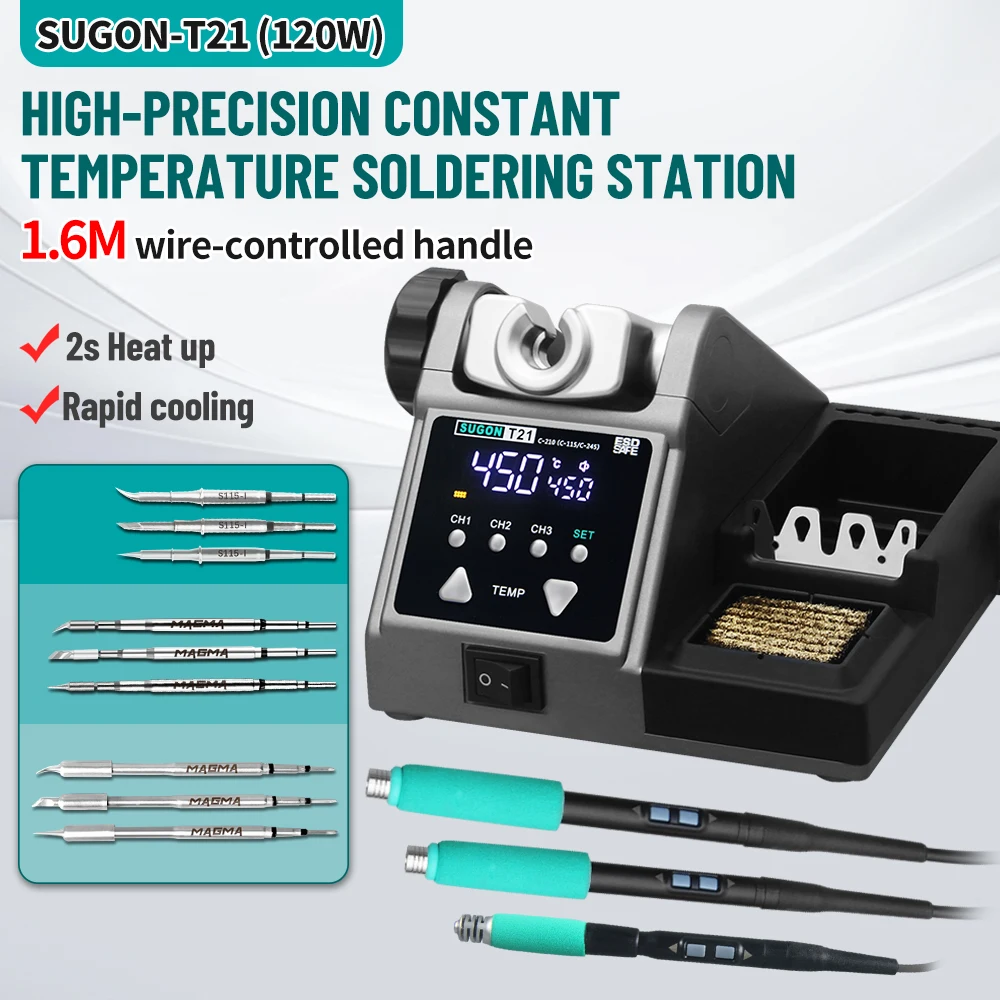
The GEEBOON TC22 and FNIRSI DWS-200 target high-power workloads, while the SUGON T21 and YIHUA 982-III emphasize handle ergonomics and accessible pricing.
Workload and Application Routing
Universal Bench Technicians
Choose a multi-standard station supporting both T12 tips and modern C-series micro-cartridges without requiring separate base controllers.
GEEBOON 220W TC22 soldering station compatible with 115/210/245/T12 soldering tip color curve display soldering rework stationHeavy Ground Plane Production
Select a 200W-class supply driving C245 handles for substantial thermal mass on multi-layer boards and large connectors.
FNIRSI DWS-200 Soldering Station 200W C210 C245 Solder Iron Handle With Soldering Helping Hand Electronic Welding Rework StationMicroscope-Bound SMD and BGA Specialists
Opt for a 120W station with grip-integrated wire controls to adjust temperatures without breaking visual focus under magnification.
SUGON T21 120W Soldering Station 1.6m Wire-Controlled Handle Electronics Soldering Iron Tip 115/210/245 Rework Station BGA ToolsBudget-Focused Learning and Entry Benches
Deploy an economical active-cartridge station compatible with C115, C210, and C245 handles under $75.
YIHUA 982-III C115 C210 C245 Soldering Iron Precision Soldering Station Control Temperature Welding Rework StationMechanical Workholding and Splices
Use a standalone passive clamp to secure loose wire harnesses and small circuit boards during manual soldering.
Auxiliary Clamp Soldering Station Helping Hand for Jewelry Crafts Circuit Board Electronic Maintenance Small Precision ProjectsCartridge Heating Architecture: Integrated Tips vs. Passive Cores
Traditional bench irons rely on passive copper tips sleeved over a separate ceramic heating core. This legacy architecture introduces significant air gaps and thermal resistance between the heater, internal thermocouple, and working tip face. When cold solder meets a heavy copper ground plane, passive tips experience steep temperature drops, often leading operators to select elevated station setpoints above 380°C, which accelerates tip oxidation and risks lifting delicate printed circuit board pads.
Modern precision soldering relies on composite cartridge systems such as C115, C210, C245, and T12. In these assemblies, the heating element, temperature sensor, and working tip are combined into a single sealed unit. The integrated thermocouple sits near the working face, allowing digital controllers to adjust power instantly as thermal load shifts.
- C115 Standard: Ultra-fine micro-soldering tips for smartphone logic boards, flex cables, and microscopic pad jumpers.
- C210 Standard: Intermediate precision cartridges for 0201 to 0805 SMD rework and dense IC leads with fast recovery.
- C245 Standard: High-capacity heavy-duty standard built for multi-layer power planes and high continuous demand.
- T12 Standard: Mature cartridge ecosystem offering dependable thermal coupling with an extensive catalog of tip profiles.
Hardware Specification Comparison
| Product | Stated Power | Cartridge Compatibility | Reference Price | Rating & Feedback |
|---|---|---|---|---|
| GEEBOON 220W TC22 soldering station compatible with… | 220W | 115 / 210 / 245 / T12 | ~$64.76 | 4.9/5% (2,097 reviews) |
| FNIRSI DWS-200 Soldering Station 200W C210 C245 Solder Iron… | 200W | C210 / C245 | ~$108.00 | 4.8/5% (1,056 reviews) |
| SUGON T21 120W Soldering Station 1.6m Wire-Controlled Handle… | 120W | 115 / 210 / 245 | ~$112.96 | 4.9/5% (289 reviews) |
| YIHUA 982-III C115 C210 C245 Soldering Iron Precision Soldering… | Unspecified | C115 / C210 / C245 | ~$74.42 | 4.9/5% (924 reviews) |
| Auxiliary Clamp Soldering Station Helping Hand for Jewelry… | Passive (N/A) | Mechanical holding | ~$10.57 | 4.9/5% (405 reviews) |


Safety and Electrical Grounding Considerations
When procuring precision soldering equipment from online marketplaces, verifying electrical safety and grounding remains essential. Sensitive components such as CMOS logic, bare MOSFETs, and high-density microcontrollers are susceptible to electrostatic discharge (ESD) and AC leakage.
Technicians should confirm that the station mains plug connects reliably to the soldering tip ground, ensuring tip-to-ground resistance remains low to protect delicate circuits during assembly and rework.
Hardware Trade-Offs and Station Limitations
- Advertised wattage ratings (200W or 220W) reflect peak burst capability; continuous power delivery is limited by cartridge thermal mass and tip geometry.
- Multi-cartridge compatibility across 115, 210, and 245 often requires purchasing additional dedicated handles and tip sets separately.
- High-output integrated stations with attached clamps demand substantial bench space compared to compact standalone base units.
- Friction ball-joint auxiliary clamps can shift under heavy hand pressure and lack the fine screw adjustments found on dedicated PCB vises.
Evaluation Scope and Data Disclosures
Known facts
All product ratings, review volumes, and prices reflect marketplace listings provided in the source documentation.
Cartridge compatibility lists and power ratings (120W, 200W, 220W) represent manufacturer specifications rather than independent lab measurements.
Analysis
Technical comparisons evaluate published electrical engineering standards for integrated composite heating elements against legacy ceramic heaters.
Ergonomic advantages such as handle-based setpoint adjustment are assessed for optical inspection workflows.
Uncertainties
Actual tip-to-ground AC leakage and tip-to-ground resistance were not measured via instrument teardown.
Specific handle configurations and cartridge packs bundled in base packages may vary across regional seller tiers.